Sundarban Luxury Tour Crocodile and Deer Spotting: Beyond the Famous Bengal Tiger
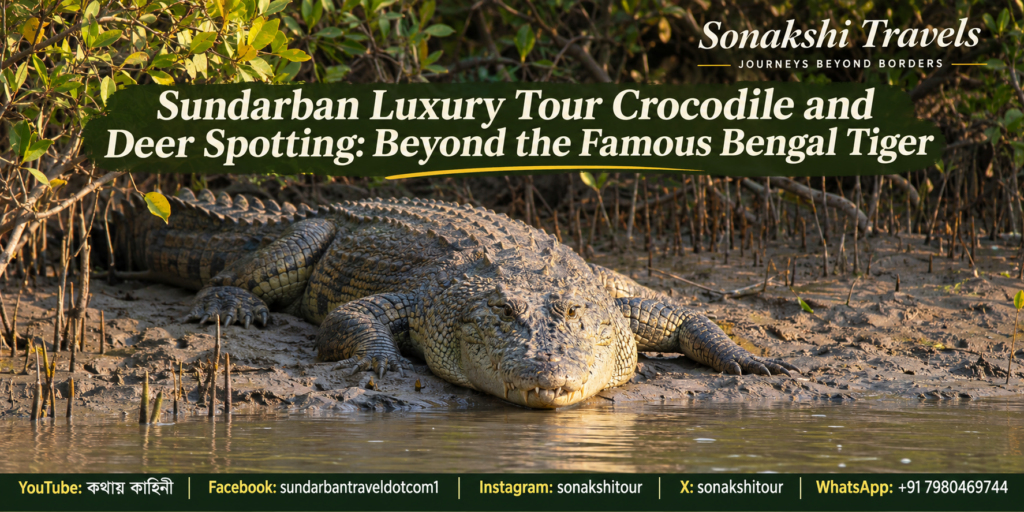
A Royal Bengal Tiger may be the most celebrated animal of the Indian Sundarbans, but two other remarkable inhabitants often make a wildlife safari equally fascinating: the saltwater crocodile and the spotted deer. Crocodiles may rest almost motionless on exposed tidal mudbanks, while groups of chital deer feed along mangrove margins or emerge briefly from dense vegetation. Both species reveal important aspects of how wildlife survives in this unusual forest of rivers and islands. A carefully organised Sundarban Tour Private Wildlife Safari offers opportunities to observe their natural behaviour from an authorised boat, with greater comfort and time for patient observation. Neither animal is guaranteed to appear, but understanding their habitats can make the search genuinely rewarding.
Crocodiles and deer occupy contrasting ecological roles. The saltwater crocodile is a powerful reptilian predator closely associated with tidal water, whereas the spotted deer is an adaptable herbivore and important prey species for the Bengal Tiger. Their presence reflects the diversity of the Sundarbans, where aquatic and terrestrial food webs meet along narrow strips of muddy shoreline. A passing boat may reveal a crocodile partly concealed by water or a group of deer standing beneath mangrove branches.
For wildlife enthusiasts, the challenge is learning where to look, how to distinguish one animal from another, and why tide, vegetation and observation distance matter. This guide focuses specifically on spotting saltwater crocodiles and spotted deer, describing their appearance, behaviour, preferred observation environments and photographic opportunities. It also explains how a private luxury safari can improve the quality of wildlife watching without compromising forest regulations or creating unrealistic expectations about sightings.
Why Crocodiles and Spotted Deer Deserve Attention Beyond the Bengal Tiger
The extraordinary appeal of the Sundarbans comes from its entire ecosystem, not from the tiger alone. Across the interconnecting waterways, mangrove roots stabilise soft sediment, tidal flows reshape the banks, and different animals exploit the changing boundary between land and water. Crocodiles and deer are particularly useful species through which to understand these relationships because they occupy very different positions in the forest food web.
Saltwater crocodiles hunt aquatic and shoreline prey and help maintain ecological processes within estuarine habitats. Spotted deer feed on available vegetation and form an important component of the prey base for tigers. Studying both therefore helps travellers understand how a seemingly quiet riverbank can support complex interactions between plants, herbivores and large predators.
Two animals, two very different wildlife encounters
A crocodile encounter may begin with an apparently motionless shape lying against wet mud. At first, a visitor may notice only a dark back, a head or a pattern of scales. The animal might remain still for several minutes, slip quietly into the water or disappear beneath the surface without attracting much attention.
Deer are usually recognised through movement, body shape or their distinctive spotted coats. An animal may turn its head towards the river, resume feeding or retreat behind vegetation. A group can provide opportunities to observe interactions between individuals, but its members may disappear rapidly into the mangroves when disturbed.
Why a tiger-free safari can still be productive
Tiger sightings depend on unpredictable movements and visibility within dense forest. By contrast, looking carefully for deer, crocodiles and other characteristic species allows visitors to engage with the environment throughout the journey. There may be periods when no large animal is visible, but the changes in shoreline, tidal water and bird activity still provide meaningful natural-history observations.

The most useful approach is not to abandon interest in the tiger, but to recognise that the Sundarbans contain many ecological stories worth understanding. A guide who helps visitors identify crocodile habitat or explains deer behaviour can make the entire safari more rewarding.
Saltwater Crocodile Spotting: Understanding the Sundarbans’ Estuarine Predator
The saltwater crocodile, scientifically known as Crocodylus porosus, is also called the estuarine crocodile. It is one of the most impressive reptiles found in the Sundarbans and is adapted to coastal, tidal and brackish-water environments. The official Sundarban Tiger Reserve identifies it as an important predator of the estuarine ecosystem and notes that crocodiles are often observed basking on mudflats.
The species is capable of using both freshwater and saline environments, but its presence in a particular channel cannot be assumed simply because the water is tidal. Individual crocodiles move according to habitat suitability, prey availability and other environmental factors. A tourist boat may pass through seemingly ideal habitat without encountering one.
How to recognise a saltwater crocodile
A saltwater crocodile has a heavy body, broad head, long muscular tail and armoured skin. Raised scales on the back create a characteristic uneven outline. When lying on mud, the body may appear dark grey, brownish or olive-toned, with colour influenced by age, lighting and wet sediment.
During observation from a moving boat, a crocodile may be visible only in part. Travellers should look carefully for the shape of the head, the alignment of the body and tail, and the distinctive arrangement of the limbs. The entire animal does not have to be exposed for an experienced observer to recognise it.
Why crocodiles rest on exposed mudbanks
Crocodiles are ectothermic animals, meaning that their body temperature is influenced by external conditions. Resting in sunshine can help with temperature regulation. A suitable mudbank or shoreline may therefore provide an important place for basking, particularly when environmental conditions favour it.
Basking is not restricted to one universally predictable hour. Cloud cover, air temperature, water temperature and the animal’s circumstances influence whether it chooses to rest in the open. Visitors should not expect every sunny bank to hold a crocodile or assume that a particular tide guarantees a sighting.
What happens when a crocodile enters the water?
A crocodile resting near the water may move with surprising speed when disturbed or when it decides to change position. Once submerged, much of its body can remain concealed. The eyes and nostrils are positioned in a way that allows it to observe and breathe while exposing relatively little of the head.
Travellers should never interpret a submerged crocodile as harmless or absent. Equally, a crocodile entering the water is not necessarily preparing to attack. Its behaviour must be interpreted cautiously and from a safe observation distance, without attempting to provoke a reaction.
Avoid confusing a crocodile with a water monitor
The Asian water monitor is another large reptile found in the Sundarbans. At a distance, its dark body and long tail may briefly resemble a small crocodile, especially when moving along a muddy bank. However, water monitors have different head proportions, body structure and movement patterns.
A crocodile generally has a heavier, more heavily armoured appearance, whereas the water monitor resembles a large lizard with a relatively elongated neck and more conspicuous walking movements. A knowledgeable guide can help distinguish them when the view is sufficiently clear.
Spotted Deer Spotting: Understanding the Chital of the Mangrove Forest
The spotted deer, or chital (Axis axis), is one of the characteristic herbivorous mammals of the Indian Sundarbans. Its reddish-brown coat with white spots makes it recognisable when an individual emerges onto open ground. However, the distinctive pattern can become much less obvious when the animal stands among dappled vegetation or shaded mangrove trunks.
Spotted deer are an important prey species for Bengal Tigers. Their presence does not prove that a tiger is nearby at that moment, but it demonstrates part of the ecological relationship that allows the region’s large predators to survive.
How to identify spotted deer correctly
Chital have slender legs, relatively large ears and a characteristic white-spotted coat. Adult males may carry branched antlers, while females and young deer do not possess the same antler structure. The size and shape of an individual can vary with sex and age.
A distant animal may initially appear as a reddish shape between tree trunks. When using binoculars, travellers should look for the spotted body pattern, upright ears and general deer silhouette rather than relying solely on colour. Correct identification becomes easier when several features are visible together.
Feeding along mangrove forest margins
Spotted deer feed on a variety of available plant material, using forest openings and suitable vegetation within their habitat. In the Sundarbans, they may be visible browsing or feeding near exposed banks where the vegetation offers accessible food.
Their diet and movements are influenced by local habitat rather than the preferences of a tourist itinerary. A deer group may remain within dense cover even when a nearby bank looks suitable for feeding. For this reason, the most practical strategy is patient scanning rather than expecting animals to appear at a particular location.
Group behaviour and vigilance
Deer are often encountered in groups, offering opportunities to observe feeding, resting, social behaviour and vigilance. Individual animals may periodically lift their heads, turn their ears or examine activity in the surrounding vegetation.
These responses can occur for several reasons, including unfamiliar sounds, movements by other animals or the presence of a boat. A sudden change in behaviour should not automatically be presented as proof of a tiger. Experienced wildlife interpretation involves recognising possibilities without claiming certainty from limited evidence.
Deer and rhesus macaques: an interesting association
Spotted deer and rhesus macaques may sometimes be observed in association within the forest. Monkeys feeding in trees can drop leaves or other plant material that deer may subsequently consume. This provides an interesting example of how animals occupying different levels of vegetation can interact.
Historical UNESCO conservation documentation includes photographs of spotted deer and rhesus macaques foraging together in the Sundarban Tiger Reserve. However, visitors should not expect both species to appear together during every deer sighting. The association is one possible natural observation, not a scheduled behaviour.
Where to Look for Crocodiles and Deer During a Private Wildlife Safari
The most useful places to look are not necessarily the same for both species. Crocodiles are closely linked to water and exposed shoreline, whereas deer are generally detected where forest vegetation meets open ground. A private boat provides a moving observation platform from which both environments can be examined, subject to the authorised route.
Exposed tidal mudbanks for crocodiles
Broad, exposed muddy banks are sensible locations to scan for basking crocodiles. Look for low, elongated shapes, a raised head or a tail extending towards the water. A partially shaded bank may make identification difficult, particularly when fallen branches or dark mud create similar outlines.
The boat should remain at a safe distance under the captain’s direction. Travellers should use binoculars or a telephoto lens rather than asking to approach a resting crocodile closely. A good sighting should not require the animal to leave its chosen position.
Forest edges and openings for deer
Deer may become visible where mangrove cover gives way to a stretch of exposed ground. Creek mouths and gaps between vegetation can also offer brief views into the forest edge. The challenge is that the animals often blend into the surrounding shadows, particularly when standing still.
Scan slowly and look for movement, upright ears or the contrast between a deer’s body and the vegetation behind it. Binoculars can help identify an animal before a camera is raised. A group may be visible only briefly before moving deeper into cover.
Observation from recognised visitor facilities
Designated locations such as Sudhanyakhali provide fixed observation opportunities near mangrove habitat and freshwater features. Depending on natural activity, visitors may look for deer or other wildlife from the authorised watchtower.
Sajnekhali also includes wildlife interpretation facilities and a crocodile-related visitor area. An animal observed in a managed pond or conservation facility must be distinguished from a wild crocodile encountered on an open riverbank. Both can be educational, but they are different kinds of experience.
The wider Sundarban luxury wildlife safari guide explains how authorised boat routes and visitor facilities contribute to a carefully planned journey through the mangrove landscape.
How Tides, Weather and Light Influence Crocodile and Deer Visibility
The Sundarbans are a tidal environment. Water levels regularly rise and fall, changing the amount of shoreline visible from the boat. These changes can influence how easily tourists detect crocodiles and deer, even when the animals have not moved far from the surrounding habitat.
Low tide and exposed shoreline
When water levels fall, wider sections of mudbank may become visible. This can create additional exposed surfaces where a crocodile might rest. It may also reveal tracks and other signs along the forest edge, although identifying a track reliably requires a suitable impression and relevant expertise.
The appearance of more mud does not automatically increase the probability of finding a crocodile or deer. Animals respond to many variables, and a suitable bank may remain empty. Tidal conditions should therefore be considered one part of the observation environment, not a guarantee.
High tide and changing visibility
At higher water levels, sections of mudbank may disappear beneath the river, reducing the exposed area available for observation. A crocodile could remain submerged or occupy a different shoreline position. Deer might still be present within the vegetation but become less visible from the boat.
High tide can also create attractive landscape compositions as water reaches closer to mangrove trunks. The value of a safari therefore changes with the visual conditions rather than simply becoming better or worse at one particular water level.
Morning and afternoon lighting
Lower-angle sunlight may help reveal texture across crocodile scales or illuminate deer standing near exposed banks. However, the opposite side of the river may remain heavily shaded, and bright reflections from water can make a partly submerged crocodile difficult to see.
Photographers should adapt to the direction of light rather than relying on a universal claim that morning is always best. The boat’s position, cloud cover, vegetation and the location of the animal often determine whether an encounter can be photographed successfully.
Choosing a comfortable travel season
The cooler tourism season can make extended river observation more comfortable for visitors, particularly when spending several hours on an open or partly shaded deck. However, pleasant weather should not be confused with assured crocodile or deer sightings.
Weather conditions, river navigation and forest access must be checked for the intended dates. Strong wind, heavy rain or poor visibility may affect observation and the practical route, even when travellers have booked a private vessel in advance.
Crocodile vs Spotted Deer: A Practical Wildlife Observation Comparison
Comparing the two species helps travellers understand why their observation strategies differ. A crocodile can remain almost invisible against wet mud despite its large size, while deer may be detected through movement within vegetation. Both require attention, but the visual clues are different.
| Observation Feature | Saltwater Crocodile | Spotted Deer |
|---|---|---|
| Scientific name | Crocodylus porosus | Axis axis |
| Ecological role | Large estuarine predator | Herbivore and important tiger prey |
| Where to look | Exposed mudbanks, shorelines and tidal water | Forest margins, suitable feeding areas and vegetation openings |
| Visual clues | Armoured body, broad head and muscular tail | White spots, upright ears and slender legs |
| Interesting behaviour | Basking, swimming and remaining partly submerged | Feeding, vigilance and group interactions |
| Observation challenge | Camouflage, submerged body and rapid disappearance underwater | Dense vegetation and sudden movement into cover |
| Safety priority | Never approach the animal or water’s edge | Avoid feeding, startling or pursuing the animals |
Neither species should be treated as a guaranteed checklist item. The comparison is intended to help visitors scan habitat more intelligently, not to imply that either animal can be found at a particular hour or along every permitted river route.
Photographing Crocodiles and Deer from a Private Safari Boat
Crocodiles and deer create very different photographic challenges. A crocodile’s textured body may offer a detailed subject when it rests in the open, while deer require faster reactions because they frequently move between vegetation and exposed ground.
Photographing crocodiles without disturbing them
A crocodile resting on mud can provide an opportunity to study texture, shape and the relationship between the animal and its tidal habitat. A telephoto lens allows the photographer to work at a responsible distance while keeping the crocodile large enough in the image for identification.
Avoid asking the captain to move dangerously close to the bank. A crocodile that abruptly enters the water because of disturbance is not a successful photographic outcome. When the animal remains calm, photographers may have time to choose between a wider environmental image and a closer composition.
Photographing deer before they disappear into vegetation
A deer sighting can develop quickly, particularly when a group crosses a visible opening. Photographers benefit from keeping a suitable lens ready and checking shutter speed before approaching a potentially interesting forest bank.
Rather than focusing exclusively on a close-up portrait, consider including some mangrove vegetation or exposed mud in the composition. This communicates the distinctive habitat and differentiates a Sundarban deer photograph from an image taken in a more open woodland reserve.
Equipment and viewing comfort
Binoculars are valuable for locating distant wildlife before using a camera. A telephoto zoom can accommodate changing distances, while a wider lens is useful when the surrounding landscape contributes to the image. The boat’s movement, wind and available light can affect sharpness, making appropriate shutter speeds and secure camera handling important.
Photographers should not balance equipment on unsafe railings or crowd one side of the boat. A well-managed private vessel provides a more comfortable observation setting, but the captain’s safety instructions must always take precedence over photography.
How a Luxury Private Wildlife Safari Can Improve the Experience
A private safari is particularly appealing to travellers interested in crocodiles and deer because careful observation is easier when the group shares similar priorities. Rather than moving through the day’s programme with unrelated passengers, guests can discuss their interests directly with the guide and plan a comfortable pace within the authorised itinerary.
The important advantage is the quality of the experience, not the ability to control wildlife. A private boat does not guarantee encounters, grant exclusive forest access or permit the crew to deviate from prescribed routes.
More personal attention during observation
An experienced guide or additional naturalist can explain the differences between a crocodile and a water monitor, draw attention to deer feeding behaviour and help visitors interpret changes in the shoreline. This guidance can be particularly useful for guests unfamiliar with the mangrove ecosystem.
Travellers should clarify whether a specialist naturalist is included or available as an additional service. The Sundarban Tiger Reserve requires ecotourism guides aboard boats entering the reserve, and a private naturalist does not automatically replace that official guiding requirement.
Comfort during extended wildlife observation
Long periods of river cruising become more enjoyable when the vessel has suitable seating, shade, drinking water and convenient facilities. Depending on the confirmed package, a private boat may also provide onboard meals, a dedicated service team and sufficient space for photography equipment.
These amenities vary by vessel and should be confirmed before booking. Travellers can review Sonakshi Travels’ private luxury Sundarban tour arrangements and request a quotation that clearly identifies the actual boat, guiding services and forest observation time.
Choosing a suitable safari duration
A single day may provide opportunities to observe crocodiles, deer and other wildlife, but additional safari time allows a visitor to experience more changing river conditions and observe different permitted habitats. No duration can guarantee a particular animal sighting.
For international travellers or photographers, the most useful comparison is often between actual forest-observation hours rather than the number of hotel nights. A Sundarban luxury tour package for international travellers should be assessed through its daily programme, private services and practical time allocated to wildlife watching.
Visitors can also compare a private Sundarban wildlife cruise package when deciding how much privacy, personal attention and observation flexibility they require.
Responsible Crocodile and Deer Watching: Safety and Conservation
The most important principle is to observe wildlife without changing its natural behaviour. The Sundarban Tiger Reserve requires tourist boats to follow prescribed routes and prohibits activities that disturb or damage the protected environment. Travellers should remain aboard their authorised vessels except at designated tourism facilities where disembarkation is permitted.
Special precautions around crocodiles
Saltwater crocodiles are powerful wild predators. Visitors should never approach the water’s edge, attempt to feed one, encourage a closer encounter or request unsafe manoeuvres near a resting animal. Even a crocodile that appears motionless deserves considerable distance.
Swimming and diving are prohibited inside the reserve. Hands, feet and photography equipment should remain safely within the boat. The captain and authorised guide should determine how the vessel operates near wildlife and whether a particular observation position is appropriate.
Avoid disturbing deer groups
Deer may become alert or move away when they detect unusual noise or activity. Visitors should keep voices low, avoid sudden shouting and never throw food towards the bank to attract animals. Feeding wildlife is inconsistent with responsible conservation practice and may alter normal behaviour.
A successful deer encounter is one in which the animals continue feeding, resting or moving naturally while visitors observe from an appropriate distance. A photograph obtained after deliberately alarming the group should not be considered a better wildlife experience.
Respect the permitted route and other visitors
Boat crews cannot deviate freely into restricted creeks for wildlife photography. Loud music, littering and other prohibited activities must also be avoided. These rules apply equally to luxury private vessels and shared tourist boats.
The same respect should extend to other observers using authorised waterways. Quiet, patient watching improves the atmosphere of the excursion and reduces unnecessary disturbance around animals that may already be sensitive to human activity.
Frequently Asked Questions About Sundarban Crocodile and Deer Spotting
Can tourists see saltwater crocodiles during a Sundarban safari?
Yes. Saltwater crocodiles inhabit the Sundarbans’ tidal waterways and may sometimes be observed resting on mudbanks or partly submerged near the shore. The Sundarban Tiger Reserve specifically identifies mudflat basking as characteristic behaviour. However, sightings depend on location, conditions and animal activity, so they cannot be guaranteed.
Are spotted deer commonly found in the Sundarbans?
Spotted deer are established inhabitants of the Indian Sundarbans and an important prey species for tigers. They may be seen along suitable forest margins, sometimes in groups. Their visibility varies with vegetation, route and behaviour, and not every safari will produce a clear sighting.
Which tidal conditions are best for crocodile photography?
Lower water levels may expose additional mudbanks, potentially making basking crocodiles easier to notice. Nevertheless, no particular tidal phase guarantees an encounter. Sunlight, water temperature, weather and individual behaviour also influence whether a crocodile occupies an exposed location.
Can crocodiles and spotted deer be observed on the same safari?
Yes, both species occur within the wider Sundarbans landscape, and a suitably planned safari may provide opportunities to look for them. However, they use different habitats, and seeing both during one excursion is never certain. Travellers should avoid expecting them to appear together at the same bank.
Does a private safari increase the chance of seeing deer and crocodiles?
A private safari can improve comfort, personal attention and the quality of observation. More actual wildlife-viewing time may create additional opportunities, but there is no dependable universal percentage demonstrating that private boats produce more sightings. All visitors remain subject to the same forest regulations.
Is it safe to photograph a crocodile from a safari boat?
Responsible photography from an authorised boat can be undertaken when the captain maintains a suitable distance and passengers follow safety instructions. Travellers should never lean beyond railings, approach the water’s edge or request that the crew disturb the animal for a closer photograph.
Discovering a Richer Sundarban Wildlife Experience
Crocodiles and spotted deer demonstrate why the Indian Sundarbans deserve attention beyond the Royal Bengal Tiger. The saltwater crocodile represents the powerful aquatic predators of the estuarine ecosystem, while spotted deer reveal the importance of herbivores within the mangrove forest’s food web. Watching either species can be a fascinating experience, particularly when visitors understand the relationship between animal behaviour, tidal conditions and the surrounding habitat.
A successful Sundarban Tour Private Wildlife Safari should provide opportunities for patient observation without promising specific animal sightings. Comfortable boats, knowledgeable guides and carefully organised itineraries can enrich the experience, but wildlife remains free to move naturally and forest regulations must always be respected.
Travellers interested in crocodile and deer photography can discuss private wildlife-focused itineraries through the Sonakshi Travels Sundarban tour website. Before booking, confirm the actual forest observation time, authorised routes, assigned vessel and guiding arrangements. The most rewarding encounter is one that reveals something genuine about the animals and the remarkable mangrove environment in which they live.
Explore Our Latest and Updated Travel Guides
-
Luxury Sundarban Private Tour Cost: What Do You Get for the Higher Price?
Luxury Sundarban Private Tour Cost: What Do You Get for the Higher Price? Luxury in the Sundarbans has a rather different meaning from luxury in a metropolitan hotel or an international beach resort. It is expressed through the freedom to explore a magnificent tidal wilderness with your chosen companions, the comfort of returning to carefully selected accommodation and the reassurance that every important aspect of…
-
What Does Luxury Mean in the Sundarbans? Beyond Five-Star Rooms and Expensive Cars
What Does Luxury Mean in the Sundarbans? Beyond Five-Star Rooms and Expensive Cars At first glance, luxury travel appears easy to define. A sophisticated hotel, an expensive vehicle, beautifully presented meals and attentive hospitality are familiar indicators of a premium holiday. Yet a Sundarban luxury tour invites travellers to reconsider these conventional measures of indulgence. In a destination where tidal rivers determine the rhythm of…
-
Why True Sundarban Luxury Is Space, Time and Personal Attention
Why True Sundarban Luxury Is Space, Time and Personal Attention There is a particular kind of luxury that cannot be adequately described through the photographs of an expensive hotel room. It is experienced in the quiet moments of a journey, when there is no need to hurry, no competition for a comfortable seat and no obligation to adjust every personal preference to the expectations of…
-
How to Choose a Genuine Sundarban Private Tour Operator: 15 Questions to Ask Before Booking
How to Choose a Genuine Sundarban Private Tour Operator: 15 Questions to Ask Before Booking Choosing a genuine Sundarban private tour operator is one of the most important decisions you will make before exploring India's remarkable mangrove wilderness. A beautifully designed website may promise an exclusive boat, comfortable accommodation, experienced naturalists and unforgettable wildlife encounters. Yet these attractive descriptions do not always explain how the…
-
Sundarban Luxury Tour Full-Day Jungle Safari: What Happens from Morning to Evening?
Sundarban Luxury Tour Full-Day Jungle Safari: What Happens from Morning to Evening? A full-day jungle safari in the Indian Sundarbans is an experience shaped by tidal rivers, dense mangrove forests, changing wildlife activity and the quiet rhythm of travelling by boat. Unlike conventional jeep safaris, visitors explore the protected landscape through authorised waterways, observing forest banks and stopping at designated tourism facilities where permitted. A…
-
Sundarban Luxury Tour Morning Safari Experience: Light, Wildlife and River Landscapes
Sundarban Luxury Tour Morning Safari Experience: Light, Wildlife and River Landscapes Morning brings a distinctive atmosphere to the mangrove waterways of the Indian Sundarbans. Soft daylight gradually reveals the forest margins, reflections move across tidal rivers, and the sounds of birds become part of the experience of travelling through this remarkable landscape. For visitors planning a Sundarban Tour Private Wildlife Safari, a well-organised morning excursion…
-
Sundarban Luxury Tour Safari Safety: Understanding Wildlife Rules and Responsible Travel
Sundarban Luxury Tour Safari Safety: Understanding Wildlife Rules and Responsible Travel Safety is an essential part of experiencing the wild mangrove waterways of the Indian Sundarbans. A luxury safari may provide a comfortable private boat, experienced service team and personalised wildlife interpretation, but these advantages must operate within the safety requirements and conservation regulations established for the protected forest. Travellers booking a Sundarban Tour Private…
-
Sundarban Luxury Tour Watchtower Guide: Sajnekhali, Sudhanyakhali and Dobanki
Sundarban Luxury Tour Watchtower Guide: Sajnekhali, Sudhanyakhali and Dobanki The watchtowers of Sajnekhali, Sudhanyakhali and Dobanki offer three different ways to experience the remarkable mangrove landscape of the Indian Sundarbans. Sajnekhali introduces travellers to the forest through wildlife interpretation and designated observation facilities, Sudhanyakhali provides views towards a freshwater pond and surrounding mangrove habitat, while Dobanki is particularly recognised for its elevated canopy walkway. For…
-
Sundarban Luxury Tour Safari Permits: Entry Rules, Guides and Boat Requirements
Sundarban Luxury Tour Safari Permits: Entry Rules, Guides and Boat Requirements Planning a private wildlife safari in the Indian Sundarbans involves more than selecting a comfortable boat and arranging accommodation. Every legitimate journey into the protected tourism areas must respect forest entry permissions, authorised guides, boat registration requirements and conservation regulations. These arrangements are particularly important for travellers booking a Sundarban Tour Private Wildlife Safari,…
-
Sundarban Luxury Tour with a Private Naturalist: A More Personalised Safari Experience
Sundarban Luxury Tour with a Private Naturalist: A More Personalised Safari Experience A Sundarban luxury tour with a private naturalist offers something that comfortable accommodation and an exclusive boat alone cannot provide: a more meaningful understanding of the extraordinary mangrove wilderness. Instead of simply travelling past forests and searching for wildlife, visitors can explore the relationships between tidal rivers, mangrove vegetation, birds, reptiles and the…
Turn Your Sundarban Plans into a Personalised Quotation
Tell Sonakshi Travels who is travelling and what you have in mind. Request availability, suitable stay options, and a clear package price for your party.
Prefer to speak directly? WhatsApp +91 7980469744 or call Sonakshi Travels.