Why True Sundarban Luxury Is Space, Time and Personal Attention
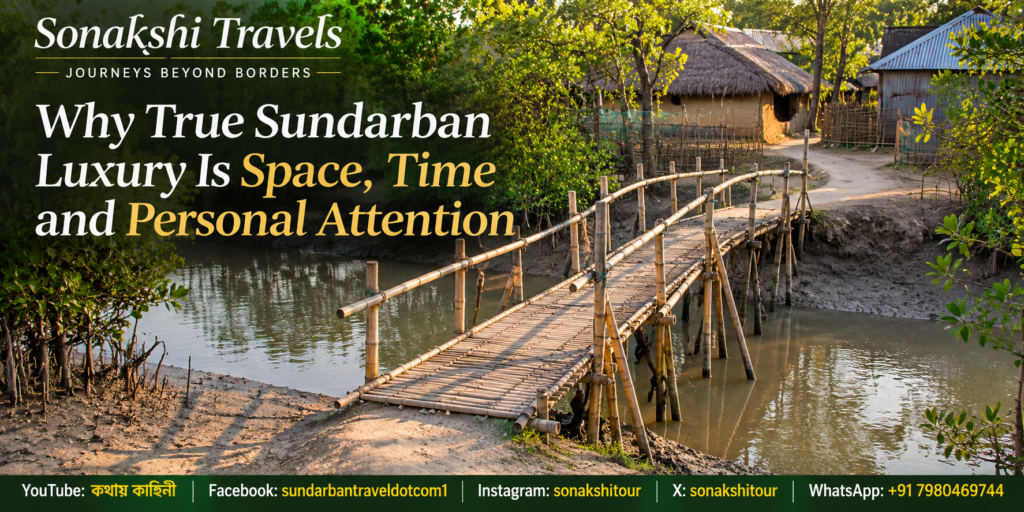
There is a particular kind of luxury that cannot be adequately described through the photographs of an expensive hotel room. It is experienced in the quiet moments of a journey, when there is no need to hurry, no competition for a comfortable seat and no obligation to adjust every personal preference to the expectations of strangers.
Imagine sitting on the upper deck of a privately reserved boat as it moves through a broad Sundarban river. The morning light touches the mangrove foliage, the breeze carries the distinctive freshness of the tidal landscape, and there is sufficient space to watch the forest without interruption.
Breakfast is served without unnecessary commotion. A knowledgeable guide explains the significance of the surrounding habitat. When an interesting bird becomes visible, everyone has an opportunity to observe it comfortably, provided the circumstances allow.
Nothing about this experience depends on elaborate decoration, expensive furnishings or conspicuous displays of wealth. Its value comes from three considerably more meaningful elements: space, time and personal attention.
These qualities are particularly significant in the Sundarban, where much of the holiday unfolds on waterways rather than within conventional tourism establishments. Premium accommodation can certainly contribute to a comfortable journey, but the real distinction between an ordinary holiday and a thoughtfully designed luxury experience often becomes apparent long before guests return to their rooms.
1. Understanding Luxury in the Context of the Sundarban
Luxury means different things in different destinations. In a metropolitan city, it may be associated with sophisticated restaurants, spacious suites and exclusive shopping experiences. At a coastal resort, it may involve sea-facing accommodation, elaborate recreational facilities and private access to selected amenities.
The Sundarban requires a different interpretation.
The landscape is defined by tidal rivers, estuarine waterways, mangrove forests and protected wildlife habitats. Tourism depends heavily on river transportation, regulated forest access and the coordination of several geographically connected services.
Visitors cannot expect the natural environment to operate according to the predictable arrangements of a conventional luxury resort.
Instead, the most meaningful premium travel arrangements are those that help guests experience this extraordinary landscape comfortably, attentively and responsibly.
Experiential Luxury Versus Material Luxury
Material luxury concerns tangible facilities such as accommodation quality, furnishings, transportation standards and available recreational services.
Experiential luxury concerns the quality of the journey itself. It includes freedom from unnecessary inconvenience, comfortable observation opportunities, thoughtful coordination and the ability to enjoy meaningful experiences without excessive pressure.
Both forms of luxury can complement each other, but they are not interchangeable.
A beautifully furnished room cannot compensate for an exhausting safari experience. Similarly, an expensive resort reservation does not automatically provide a suitable private boat, attentive guiding or well-coordinated transportation.
Travellers should therefore assess the complete journey rather than treating the accommodation category as the sole indicator of package quality.
2. Space: The First Essential Element of Sundarban Luxury
Space becomes exceptionally valuable when travellers spend several hours aboard a tourist vessel.
Unlike a conventional sightseeing vehicle, a safari boat functions simultaneously as transportation, an observation platform, a dining environment and a place of relaxation.
The available passenger space consequently influences almost every aspect of the daytime experience.
The Freedom to Enjoy the Boat Comfortably
On a shared excursion, passengers may need to coordinate seating, viewing positions and movement with several unrelated travelling groups. This can work satisfactorily when the vessel is appropriately managed, but individual preferences cannot always receive equal priority.
A privately reserved vessel can provide a more controlled passenger environment.
Guests may have greater freedom to organise seating arrangements, keep personal belongings within reach and enjoy conversations without competing with the activities of strangers.
Families travelling with children can arrange their available space according to their requirements. Couples can appreciate quieter surroundings, while senior travellers may benefit from comfortable seating and reduced passenger movement around them.
These advantages depend on the actual vessel layout and the number of booked passengers. A private reservation alone does not establish that the boat will be spacious, accessible or appropriately equipped.
Why Usable Deck Space Matters More Than Boat Size
Travellers frequently associate larger vessels with greater comfort. However, the important consideration is not necessarily the overall size of the boat but the amount of usable passenger space available within its design.
Seating arrangements, protective railings, walking areas, roof structures and equipment placement can all influence how comfortably passengers observe the surrounding landscape.
This distinction becomes especially important for wildlife photographers who carry cameras, telephoto lenses and other equipment.
The detailed guide private sundarban photography tour how more deck space changes your safari explores how observation positions, passenger movement and deck arrangements can influence the photographic experience.
Even travellers who have no professional interest in photography can benefit from these same principles. Sufficient viewing space allows passengers to appreciate the riverbanks without constantly negotiating their position on the vessel.
Personal Space Without Environmental Intrusion
It is important to distinguish passenger exclusivity from environmental exclusivity.
A private boat may be reserved exclusively for one family or travelling group, but the rivers and protected forest areas remain part of a shared natural landscape governed by applicable regulations.
Other authorised vessels may use the same waterways, and wildlife must never be approached or disturbed merely because passengers have paid for a premium experience.
True luxury creates greater personal comfort without claiming ownership over the natural environment.
3. Time: The Luxury of Experiencing Nature Without Unnecessary Haste
Time is one of the most underestimated components of premium travel.
In the Sundarban, its importance becomes especially apparent because nature does not follow a predetermined sightseeing schedule.
The appearance of a riverbank changes with tidal conditions. Birds move according to feeding opportunities, light changes throughout the day, and larger animals may remain concealed within the vegetation for extended periods.
An itinerary that concentrates exclusively on reaching the next destination can overlook the value of these changing circumstances.
Allowing the Landscape to Reveal Itself
A river journey may initially appear uneventful to someone unfamiliar with mangrove environments.
Gradually, however, small details become noticeable. Exposed roots reveal adaptations to waterlogged conditions. Movement along the muddy shoreline may indicate the presence of small animals. A bird resting on a branch becomes easier to recognise when there is sufficient opportunity to observe its characteristics.
These experiences reward attention rather than speed.
Thoughtfully coordinated safari arrangements can help visitors appreciate such moments when conditions, operating requirements and forest regulations permit.
The aim is not to remain indefinitely at a particular location but to avoid treating every minute of the journey as an obstacle between scheduled attractions.
Giving Each Forest Tourism Location Its Proper Value
Recognised destinations such as Sajnekhali, Sudhanyakhali and Dobanki offer different opportunities for environmental interpretation, wildlife observation and appreciation of mangrove vegetation.
Each location deserves to be understood according to its individual characteristics rather than simply added to a list of completed sightseeing points.
The related article sajnekhali sudhanyakhali and dobanki what each stop adds to a private sundarban tour explains these complementary experiences and their respective contributions to a responsible wildlife holiday.
A meaningful premium itinerary should consider how visitors will experience the proposed destinations, not merely whether their names appear in the package description.
Time Does Not Mean Unrestricted Forest Access
Private travel arrangements cannot override forest entry permissions, approved tourism routes, operating schedules or the safety decisions of authorised personnel.
Even a generously priced luxury package must operate within these requirements.
Flexibility therefore concerns the intelligent coordination of available time rather than unlimited access to the protected landscape.
Responsible operators should communicate this distinction clearly. Guests should never be encouraged to expect prohibited activities, unrestricted route changes or guaranteed wildlife encounters.
4. Personal Attention: The Human Element That Defines Premium Travel
While accommodation and transportation are visible components of a holiday, the quality of personal attention is often what determines how smoothly the complete journey unfolds.
Personal attention does not necessarily mean elaborate ceremonial hospitality. It means understanding what travellers require, anticipating practical difficulties and coordinating services accordingly.
This is particularly valuable in the Sundarban because a holiday involves several interconnected arrangements, including road transfers, boat boarding, accommodation, meals, guiding and forest permissions.
Understanding the Travellers Before Departure
A personalised journey should begin with an understanding of the travelling group.
A family with young children may have different meal requirements from a group of dedicated wildlife photographers. Senior travellers may prefer straightforward boarding arrangements, while international visitors may appreciate additional assistance with environmental interpretation and communication.
These requirements should influence the organisation of the holiday before the guests arrive.
When reviewing a Sundarban private tour package, travellers should therefore ask whether personalisation extends beyond choosing an accommodation category or departure date.
Meaningful customisation should be reflected in confirmed arrangements appropriate to the group’s interests and practical needs.
The Importance of Coordinated Tour Management
A dedicated tour coordinator, where included in the reservation, can provide an important connection between the different services involved in the journey.
Transportation schedules must correspond with boat boarding arrangements. Meal preparation must complement the day’s activities. Accommodation transfers need to be coordinated with authorised safari completion times.
When these elements are managed effectively, guests can concentrate on the experience rather than repeatedly resolving logistical questions.
Such coordination may be relatively unobtrusive, but its absence can become immediately apparent when arrangements are delayed, misunderstood or poorly communicated.
Professional attention is therefore best measured through reliability, responsiveness and clarity rather than the number of hospitality gestures performed during a holiday.
Guiding That Adds Understanding Rather Than Noise
A knowledgeable guide can contribute significantly to the quality of a Sundarban journey.
Instead of limiting explanations to the names of tourist destinations, an attentive guide can help visitors understand the ecological significance of mangrove vegetation, tidal movements, bird behaviour and wildlife habitats.
The depth of interpretation should be appropriate to the interests of the travelling group.
Children may respond well to simple explanations, while experienced nature enthusiasts may appreciate more detailed discussions about species identification and ecological relationships.
Equally important is the ability to recognise when guests wish to observe the surroundings quietly.
Good personal attention includes respecting silence rather than filling every moment with conversation.
5. Accommodation, Dining and Transportation as Supporting Elements of Luxury
Space, time and personal attention do not make physical facilities irrelevant. Comfortable accommodation, appropriate transportation and thoughtfully organised meals remain important components of a premium holiday.
Their greatest value, however, emerges when they support the overall experience instead of functioning as isolated attractions.
Accommodation Should Complement the Safari
After a prolonged day on the waterways, guests may appreciate comfortable bedding, a well-maintained bathroom, suitable air conditioning and an environment that allows them to rest peacefully.
Premium resort accommodation can provide additional hospitality and recreational facilities for travellers who intend to make meaningful use of them.
However, a luxury experience does not necessarily require the most expensive room category.
A well-maintained private cottage may be entirely appropriate for guests whose priorities are wildlife observation, exclusive boat arrangements and comfortable overnight accommodation.
The accommodation investment should reflect how the property will actually be used during the holiday.
Dining That Reflects Individual Preferences
Thoughtfully arranged meals can add considerably to the comfort of a private Sundarban journey.
Families may appreciate less spicy food for children. Vegetarian travellers may require suitable meal preparation arrangements. Other guests may prefer traditional Bengali cuisine featuring ingredients available within the agreed menu.
Where a dedicated onboard cook or personalised catering service is included, dietary preferences should be communicated sufficiently early to allow appropriate preparation.
Personal attention should not be confused with unlimited menu availability. Ingredient sourcing, food storage, kitchen facilities and preparation requirements establish practical limitations.
Luxury in this context means receiving suitable, hygienically prepared meals that complement the journey and reflect previously agreed preferences.
Reducing Friction During Road and Boat Transfers
The journey between Kolkata and the Sundarban involves transportation arrangements that should be considered part of the holiday rather than an administrative necessity.
Suitable vehicle selection, luggage management, clear pickup instructions and coordinated boarding arrangements can influence the comfort of the entire experience.
Travellers considering a Sundarban private tour should establish whether exclusive road transportation, private boat reservation, guiding and accommodation are included together or offered as separately configurable services.
A well-designed luxury itinerary reduces unnecessary uncertainty between these different stages without making unrealistic promises about traffic, weather or other external conditions.
6. Advantages and Disadvantages of a Personalised Luxury Sundarban Holiday
Private luxury arrangements can offer meaningful advantages, but they are not automatically the most suitable option for every traveller.
Understanding their practical strengths and limitations helps visitors decide whether the additional expenditure corresponds with their actual requirements.
Principal Advantages
- Greater passenger privacy: Exclusive boat arrangements can reduce the need to share passenger facilities with unrelated tourist groups.
- More usable observation space: An appropriately selected vessel may provide better opportunities for comfortable wildlife viewing and photography.
- Personalised travel coordination: Pickup, meals, accommodation and guiding can be organised according to confirmed group requirements.
- Improved comfort for families: Children and senior travellers may benefit from more thoughtfully coordinated seating, meal and rest arrangements.
- Greater educational value: Suitable guiding can support deeper appreciation of mangrove ecology and wildlife behaviour.
- Flexible service selection: Travellers may be able to prioritise the components that matter most, rather than paying for an unsuitable standardised arrangement.
Potential Disadvantages and Limitations
- Higher expenditure: Exclusive transportation, private vessel operation and dedicated personnel may increase the overall package cost.
- Reduced financial efficiency for small groups: Couples and solo travellers may bear a larger proportion of the fixed operating expenses.
- Advance coordination requirements: Specific dietary, accessibility and guiding needs should be communicated before departure.
- Variation between operators: The terms private, premium and luxury do not guarantee identical service standards across different providers.
- Environmental uncertainty: Weather, tides, wildlife behaviour and official restrictions remain beyond the control of a luxury reservation.
- Limited additional value from unused facilities: Expensive accommodation upgrades may offer little benefit when guests spend nearly all available daylight hours on safari.
The most effective decision is not necessarily to select the highest-priced package. It is to identify which premium arrangements will produce a meaningful improvement in the quality of the proposed holiday.
7. How Different Travellers Can Define Their Own Luxury Experience
A successful private holiday should reflect the people undertaking it rather than a universal definition of luxury.
Different groups may value different combinations of comfort, privacy, observation opportunities and personal assistance.
Couples Seeking Peaceful Time Together
For couples, luxury may involve a quiet passenger environment, comfortable accommodation and freedom from unnecessary social obligations.
They may prefer enjoying the river scenery together rather than participating in a tightly coordinated group programme.
In this situation, exclusive boat arrangements and thoughtful residential comfort may contribute more value than an extensive list of sightseeing activities.
Families and Senior Travellers
For families, luxury may mean fewer logistical difficulties.
Appropriate vehicle arrangements, secure boarding assistance, suitable meals and comfortable seating can reduce the practical challenges associated with travelling through a river-based destination.
Senior travellers may place particular importance on accessibility, bathroom facilities and manageable movement between accommodation and the vessel.
These requirements should be assessed individually rather than assuming that a premium package automatically resolves every mobility concern.
Photographers and Dedicated Nature Enthusiasts
For wildlife photographers, the most valuable luxury may be sufficient working space, appropriate observation positions and knowledgeable interpretation.
These travellers may prefer a longer authorised wildlife programme over elaborate resort facilities.
Equipment protection, charging arrangements and coordinated passenger movement can become more important than decorative accommodation features.
The essential principle is that luxury should be defined through the intended experience, not through the price or prestige of individual facilities.
8. Practical Booking Considerations: How to Recognise Genuine Luxury
Luxury travel descriptions can sometimes concentrate heavily on attractive photographs and broad promises while providing insufficient information about the actual services included.
Before confirming a Sundarban holiday, travellers should request clear details that allow them to evaluate the quality of the proposed arrangements.
Examine the Boat Rather Than the Package Label
Ask for information about the actual vessel assigned to the travelling group.
Establish the available passenger space, seating arrangements, weather protection, toilet facilities and safety equipment.
Confirm that the boat will be reserved exclusively for the booked passenger group if exclusivity is an essential requirement.
Understand the Itinerary and Its Limitations
Request a realistic description of the proposed safari programme, including the planned tourism locations and the general organisation of each day.
Ask how necessary modifications will be communicated if weather, navigation or forest regulations affect the original programme.
A dependable operator should distinguish between confirmed services and activities that remain subject to external conditions.
Identify Who Will Provide Personal Attention
Clarify whether the package includes a tour manager, forest guide, dedicated cook or additional naturalist support.
These roles should not be assumed to be identical. Each may involve different responsibilities, qualifications and service arrangements.
Travellers requiring specialised wildlife interpretation or particular language assistance should confirm the availability and cost of appropriate support.
Compare Complete Quotations
A meaningful financial comparison should examine accommodation, transportation, vessel exclusivity, meals, guiding, applicable permissions and cancellation conditions together.
Two similarly priced packages may provide considerably different experiences when their actual inclusions are examined.
Written confirmation of essential services provides a stronger foundation for decision-making than informal promises about luxury standards.
9. Practical Travel Checklist for a Luxury Sundarban Journey
The following checklist can help travellers prepare for a comfortable and responsibly organised private holiday.
Before Confirming the Reservation
- Identify the actual accommodation property and room category.
- Confirm exclusive passenger boat arrangements where required.
- Request current photographs or specifications of the proposed vessel.
- Check seating, observation space and onboard toilet facilities.
- Establish the proposed safari programme and applicable limitations.
- Confirm road transportation, pickup and return arrangements.
- Clarify forest permissions, guiding services and applicable charges.
- Discuss dietary preferences, accessibility and individual requirements.
- Obtain written confirmation of payment and cancellation conditions.
Before Travelling
- Carry the identification documents required for the confirmed itinerary.
- Pack suitable clothing for seasonal weather conditions.
- Bring comfortable footwear for boarding and designated visitor facilities.
- Carry binoculars or appropriate photography equipment if desired.
- Keep necessary personal medication and essential health information accessible.
- Confirm arrangements for drinking water, meals and luggage.
- Allow adequate time for onward flights, trains or other travel commitments.
During the Holiday
- Respect the instructions of forest officials, guides and boat personnel.
- Avoid unnecessary noise around wildlife observation areas.
- Remain within authorised visitor facilities.
- Do not feed, pursue or deliberately disturb wildlife.
- Accept necessary itinerary modifications when safety or conservation requires them.
- Use water and electricity responsibly at accommodation properties.
- Dispose of waste appropriately and respect local communities.
These preparations allow guests to enjoy the benefits of personalised travel while recognising their responsibilities within an environmentally sensitive destination.
Luxury Is How the Journey Makes You Feel
The most memorable moments of a Sundarban holiday may have little connection with the visible symbols of conventional luxury.
They may arise while watching the morning light spread across a tidal river, enjoying a freshly prepared meal aboard a comfortable boat or listening to a guide explain a small but fascinating detail of the surrounding mangrove habitat.
Such experiences become more meaningful when travellers have sufficient space to enjoy them, sufficient time to appreciate them and thoughtful personal attention to support the journey.
Premium accommodation, comfortable transportation and well-organised hospitality can strengthen this experience, but their purpose should always remain connected to the overall quality of the holiday.
True Sundarban luxury is not measured by the number of expensive facilities included in a quotation. It is measured by the freedom from unnecessary inconvenience, the quality of meaningful observation and the care with which individual requirements are understood.
Above all, genuine luxury in the Sundarban respects the character of the destination. It does not attempt to control wildlife, dominate the landscape or override conservation requirements.
It creates the conditions in which travellers can experience nature comfortably, responsibly and without unnecessary haste.
In a world where time is frequently limited and personal space is increasingly difficult to find, the opportunity to travel through a remarkable natural landscape with both may represent one of the most valuable luxuries of all.